
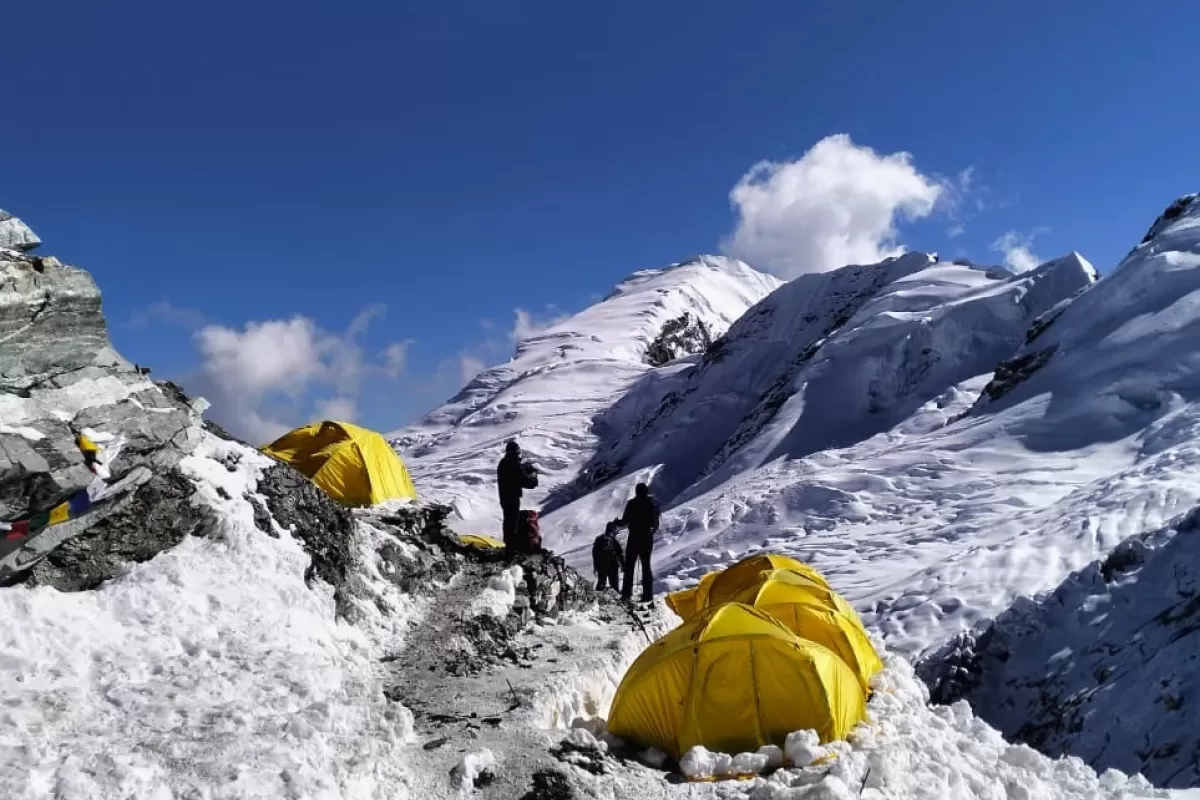
Mera Peak, at 6,476 meters (21,247 feet), is the highest trekking peak in Nepal, located in the Solu-Khumbu region. It offers an accessible non-technical climb for trekkers with basic mountaineering skills. The ascent involves glacier travel, steep slopes, and high-altitude conditions, requiring equipment like crampons and ice axes. Climbers typically stop at Mera Base Camp (5,300m) and High Camp (5,800m) before summiting.
Summiting Mera Peak offers stunning panoramic views of Everest, Lhotse, Makalu, and Cho Oyu. Although considered a trekking peak, the climb is physically demanding and requires proper acclimatization. Mera Peak is a popular choice for those seeking high-altitude mountaineering experience, often serving as a preparatory climb for Everest and other major peaks.
Welcome to Nepal, the land of the Himalayas.
Upon your arrival at Tribhuvan International Airport in Kathmandu, our representative will welcome you and transfer you to your hotel. After check-in, you will have time to rest and recover from your journey.
Depending on your arrival time, your climbing guide will provide an initial briefing about the Mera Peak expedition, including the itinerary, safety procedures, altitude acclimatization, equipment and general preparation.
In the evening, you can enjoy a traditional Nepali welcome dinner and meet your climbing team.
Overnight in Kathmandu
Today is dedicated to exploring the cultural heritage of Kathmandu and preparing for the Mera Peak adventure.
After breakfast, you will visit some of the major cultural and historical attractions of Kathmandu Valley. Depending on the program and available time, visits may include Boudhanath Stupa, Pashupatinath Temple, Swayambhunath Stupa and Kathmandu Durbar Square.
The sightseeing provides an introduction to Nepal's rich cultural and religious heritage before heading into Himalayan wilderness.
Later, we check and organize climbing equipment, clothing and personal gear. Your guide will also provide a detailed briefing about the trek, altitude, weather, safety and climbing procedures.
Overnight in Kathmandu
After an early breakfast, we begin our overland journey from Kathmandu toward the Sou-Khumbu region.
The road passes through Nepal's beautiful middle hills, with changing landscapes of rivers, terraced farmland, forest and traditional villages. We continue toward the Solu region and eventually reach Ringmu.
Ringmu is a beautiful mountain settlement surrounded by forest and hills. The area is also known for Taksindu Monastery, an important Buddhist monastery in the Solu region.
This overland approach allows us to begin the trek from the quieter southern side of the Everest region.
Overnight in Ringmu
After breakfast, we begin our first major trekking day.
The trail passes through beautiful forests, terraced farmland. Taksindu Monastery and traditional mountain settlememts. We gradually descend and ascend through the hills while enjoying views of the surrounded Solu region.
The landscape changes from cultivated hillsides to forestd mountain trails. Along the way, we encounter local communities whose traditional livelihoods are based on agriculture, livestock and tourism.
Kharikhola is a traditional mountain settlement and an important stopping point on the route toward Pangom and the Hinku Valley.
Overnight in Kharikhola
Today the trail becomes more mountainous as we leave Kharikhola and climb toward Pangom.
The route follows forested trails with several uphill and down sections. We pass through rhododendron and bamboo forests and enjoy views over the deep valleys and surrounding mountains.
The final section involves a steady ascent toward Pangom, a traditional mountain village with a strong Sherpa culture influence.
Pangom is an important gateway toward the remote Hinku Vallley and Mera Peak region.
Overnight in Pangom.
After breakfast, we leave Pangom and begin climbing toward the beautiful ridge of Ramailo Danda.
The trail passes through pine, bamboo and rhododendron forests with a mixture of ascents and descents. We cross the Pangom La area and continue along a scenic ridge.
Ramailo Danda means approximately "beautiful ridge/hill", and it provides an impressive viewpoint over the surrounding valleys. Depending on weather conditions, this is one of the places where we can obtain our first memorable views toward the Mera Peak region.
This is also an excellent opportunity to experience the quiet and remote character of the lower Solu region.
Overnight Ramailo Danda.
Today we descend from Ramailo Danda toward Chhatra Khola.
The trail passes through dense rhododendron, bamboo and pine forests. There are several ascents and descents, and some sections can be narrow, muddy or slippery, particularly during the rainy season.
We enter the remote forests landscape of the Makalu-Barun region and follow sections of Pasang Lhamu trail.
The area is rich in Himalayan flora and fauna, and trekkers may encounter a variety of birds and wildlife. The elusive red panda is also associated with the forests of this region, although sightings are rare.
After several hours of walking. we reach Chhatra Khola, a peaceful settlement beside the river.
Overnight in Chhatra Khola.
Today we enter the main Hinku Valley.
The trail initially follows the Majang Khola and gradually connects with the Hinku Khola. We continue through forests and rugged mountain terrain, crossing several small streams and passing seasonal settlements and grazing areas.
As we progress northward, the valley becomes increasingly alpine and the surrounding mountains become more dramatic.
The trail eventually reaches Kothe, an important settlement in the Hinku Valley and a major stopping point for climbers heading toward Mera Peak.
Overnight in Kothe.
Today is a relatively short but important high-altitude trekking day.
We follow the Hinku Khola northward, gradually gaining elevation. The vegetation becomes thinner as we move deeper into the alpine environment.
Along the trail, we pass Gondishung, a traditional seasonal settlement used by local yak herders. We aslo pass the historic Lungsungba Gompa, where climbers and trekkers often stop for a moment of reflection and blessing.
As we continue, Mera Peak and surrounding mountain walls become increasingly impressive.
We arrive at Thagnak, a seasonal high-altitude settlement and an important acclimatization point.
Overnight in Thagnak.
Today we enter the high-altitude environment of the Mera Peak climbing region.
The trail follows the upper Hinku Valley, gradually climbing toward Khare. As we gain altitude, the vegetation becomes sparse and the landscape changes into rugged alpine terrain.
We pass through areas near the Hinku Nup Glacier and Shar Glacier, depending on the exact route and seasonal trail conditions.
The final section toward Khare becomes steeper, but the spectacular views of Mera Peak and surrounding peaks provide a storng motivation.
Khare is the main preparation point for the Mera Peak ascent and is located at approximately 5000 metres.
Overnight in Khare.
Today is an important acclimatization and preparation day.
Rather than simply resting all day, we take a short acclimatization hike around Khare and gradually expose our bodies to higher altitude.
Your climbing guide will also provide practical training and instruction, including:
• Crampon fitting and use
• Ice axe techniques
• Walking on snow and ice
• Rope techniques
• Glacier safety
• Basic crevase awareness
• Ascending and descending on snow
• Use of climbing harness and safery equipment
• Summit-day procedures
• Altitude and weather awareness
The climbing team will check all equipment before the ascent and prepare the loads for High Camp.
An early dinner and good rest are important because the following day takes us to approximately 5800 metres.
Overnight in Khare
Today we leave Khare and begin the climbing section of the expedition.
The trail initially crosses rocky terrain before reaching the Mera Glacier. From this point, crampons and appropriate climbing equipment are used according to the conditions.
We ascend gradually across snow and glacial terrain toward Mera High Camp. The route becomes increasingly exposed and the surrounding scenery becomes spectacular.
As we gain elevation, we can enjoy views toward Mera, Baruntse, Chamlang, Makalu and other Himalayan peaks.
After reaching High Camp, the climbing team prepares for the summit attempt. we check harnesss, crampons, ropes, ice axes, headlamps, clothing and other essential equipment.
Dinner is served early, and climbers are encouraged to sleep as much as possible before the very early summit start.
Overnight Mera High Camp.
Summit Day
Today is the main objective of the expedition: the summit of Mera Peak.
We normally wake around 1.00-200 AM, depending on weather conditions, route conditions and the decision of the climbing guide.
After a light breakfast and final equipment check, we begin climbing in the darkness.
The early part of the ascent takes place over snow and glacier terrain. Climbers move at a steady and controlled pace, with regular short breaks to maintain energy and manage the altitude.
As dawn approaches, the surrounding Himalayan peaks begin to appear.
The final section leads toward the summit ridge. With favorable weather and safe mountain conditions, we continue toward the summit of Mera Peak.
Mera Peak Summit
Standing at approximately 6,476 metres, the summit provides an exceptional Himalayan panorama.
From the summit area, climbers may see sonme of the world's highest mountains, including:
• Mount Everest
• Lhotse
• Makalu
• Cho Oyu
• Kanchenjunga
• Baruntse
• Chamlang
• Nuptse
• Ama Dablam and other surrounding peaks.
After celebrating the achievement and taking photographs, we begin our descent.
Descending is equally important as ascending, and climbers must remain focused because fatigue increases after a long summit push.
We descend toward the lower mountain area and continue to Khare as conditions and the team's energy allow.
Overnight in Khare
Important: Summit day is weather- and condition-dependent. The climbing leader has the final decision regarding the safest time to start, continue, turn around or postpone the summit attempt.
After the demanding summit day, we begin our descent through the Hinku Valley.
The trail follows the route back toward Thangnak and then continues down toward Kothe.
As we lose altitude, the landscape becomes greener and the air becomes noticeably more comfortable.
The descent provides an opportunity to appreciate the scenery that may have been difficult to enjoy during the ascent.
We arrive at Kothe and enjoy a well-deserved rest after the summit.
Overnight in Kothe.
Today we leave Kothe and begin climbing toward Thuli Kharka.
Although we are descending overall toward Lukla, today's trail includes uphill sections ans undulating terrain.
The route passes through forests and high-altitude grazing areas. We gradually gain elevation toward Thuli Kharka, also known in some itineraries as Zatrwa Buk.
The surrounding landscape becomes increasingly open, with impressive views toward the Hinku and Dudh Koshi valleys.
After reaching Thuli Kharka, we rest and prepare for the final major pass crossing of the expedition.
Overnight in Thuli Kharka.
Today is our final major trekking day.
We begin with a gradual climb toward Zatrwa La Pass, reaching approximately 4,610 metres.
From the pass, we can enjoy beautiful views across the surrounding Himalayan landscape and look back crossed during our expedition.
After crossing Zatrwa La, the trail descends steeply toward Chutanga and continues toward Lukla.
The descent becomes progressively easier as we lose altitude and return to the greener environment of the lower mountains.
After reaching Lukla, we celebrate the successful completion of our Mera Peak climbing adventure with the climbing team.
Overnight in Lukla.
After breakfast, we take our scheduled flight from Lukla to Kathmandu, subject to weather and airport operating conditions.
The mountain flight provides one final opportunity to enjoy aerial views of the Himalayan landscape.
Upon arrival in Kathmandu, our representative will transfer you to your hotel.
The remainder of the day is free for relaxation, shopping, enjoying the atmosphere of Thamel or celebrating the successful completion of your Mera Peak expedition.
Overnight in Kathmandu.
Today marks the end of your Mera Peak Climbimg adventure in Nepal.
Depending on your international flight schedule, our representative will transfer you to Tribhuvan International Airport for your onward journey.
We hope you return home with unforgettable memories of the Himalayas, the people, the culture and the achievement of standing on Mera Peak.
Farewell and safe journey home!
Our Mera Peak Climbing package is designed to provide comprehensive support throughout the trekking and climbing period. The following services and facilities are included in the package price:
1 : Airport Transfers
• Airport pick-up upon your arrival at Tribhuvan International Airport, Kathmandu.
• Private transfer from the airport to your hotel.
• Airport transfer for your international departure.
• All necessary ground transportation as mentioned in the itinerary.
2 : Accommodation in Kathmandu
• Comfortable hotel accommodation in Kathmandu as specified in the itinerary.
• Twin-sharing accommodation on a bed-and-breakfast basis.
• Pre-trek and post-trek hotel accommodation according to the confirmed itinerary.
3 : Kathmandu Sightseeing
• Guided sightseeing in Kathmandu arrording to the itinerary.
• Professional local guide where required.
• Entrance fees to the sightseeing sites specially mentioned in the package itinerary.
4 : Transportation to and from the Trekking Region
• Private road transportation from Kathmandu to Ringmu at the beginning of the trek.
• Necessary transportation according to the confirmed itinerary.
• Lukla-Kathmandu domestic flight where applicable to the confirmed program.
5 : Mera Peak Climbing Permit and Official Fees
• Mera Peak Climbing permit issued through the Nepal Mountaineering Association ( NMA ).
• Sagaramatha National Park / applicable protected-area entry fees.
• Applicable local government or rural municipality entry fees.
• Necessary trekking and climbing documentation arranged by the company.
• Government taxes and applicable official service charges.
Permit fees are seasonal and may change according to government / NMA regulations.
6 : Professional Trekking and Climbing Guide
• Experienced, government - lincensed trekking guide throughout the trekking section.
• Professional and appropriately qualified climbing guide/Sherpa for the Mera Peak climbing section.
• Guide salary, food, accimmodation and transportation.
• Guide's insurance and necessary staff equipment.
• Pre-climb safety briefing and summit-day equipment preparation.
7: Porter Service
• Porter support during the trekking section.
• Normally one porter is provided for every two climbers, subject to the agreed group arrangement.
• Porter salary, food, accommodation, transportation, and insurance.
• Baggage carried within the agreed weight limit.
8 : Accommodation During the Trek
• Teahouse / Lodge accommodation throughout the trekking section.
• Twin-sharing rooms where available.
• Tent accommodation at Mera High Camp and other camping locations required by the itinerary.
• Camping tents, kitchen arrangements and necessary camp logistics during the climbing period.
9 : Meals During the Trek and Climb
• Breakfast, lunch and dinner throughout the trekking and climbing period as specified in the itinerary.
• Freshly prepared meals during the camping / climbing section.
• Tea and coffee during the climbing period where included in the camp service.
• Meals for guides, porters and climbing staff.
10 : Mera Peak Climbing Training
A dedicated climbing preparation and training session is provided at Khare before the ascent, including:
• Crampon fitting and walking techniques.
• Ice axe handling.
• Harness and climbing-system familiarization.
• Ascender / Jumer use where required.
• Fixed-rope techniques.
• Basic glacier travel and safety procedures.
• Rope-management and summit-day safety briefing.
The training is designed particularly for climbers who are undertaking their first Himalayan climbing experience.
11: Group Climbing Equipment
The package includes the main group equipment required for the climbing operation, such as:
• Climbing ropes and fixed ropes where required.
• Ice screws and snow protection equipment where required.
• Snow bars/pickets and other group protection equipment.
• Carabiners and basic group technical equipment.
• Climbing/camping equipment required for the high-altitude support operation.
Personal climbing equipment remains the responsibility of each climber unless specificially stated otherwise.
12 : Camping and High-Altitude Support
• High Camp tent setup and dismantling.
• Kitchen and dining arrangements where camping is required.
• Cooking equipment and necessary camp supplies.
• High-Altitude climbing logistics.
• Support staff required for the climbing operation.
13 : Safety and Medical Support
• Comprehensive first-aid kit carried by the trekking / climbing team.
• Basic altitude monitoring and regular health checks by the guide.
• Emergency communication support where available.
• Standard emergency coordination by the company in case of illness or injury.
14 : Equipment Provided by the Company
Depending on availability and prior confirmation, the company can provide selected group or rental equipment such as:
• Sleeping bag.
• Down jacket.
• Duffel bag for the trek.
• Basic climbing equipment must be returned to the company at the end of the trip.
15 : Company Services and Documentation
• Pre-trel briefing.
• Detailed itinerary and climbing preparation guidance.
• Trekking route information.
• Assistance with permits and official documentation throughout the itinerary.
• Trip coordination throughout the itinerary.
• Mera Peak summit achievement certificate upon successful complention, where provided by the company.
16 : Government Taxes and Service Charges
• Applicable government taxes.
• Company service charges related to the included services.
• Staff insurance and statutory costs as applicable.
The following expenses are not included in the Mera Peak Climbing package and should be budgeted separately.
1 : International Flights
• International airface to and from Nepal.
• Airport taxes and charges associated with international flights where not included in the airline ticket.
2 : Nepal Entry Visa
• Nepal tourist visa fee.
• Visa extension charges, if required.
3 : Travel and Rescue Insurance
Travel insurance is mandatory for Mera Peak climbing.
Your insurance should specifically cover:
• High-altitude trekking and mountaineering.
• Mera Peak climbing up to approximately 6,500 metres.
• Emergency medical treatment.
• Helicopter evacuation.
• Mountain rescue.
• Trip cancellation/interruption where applicable.
• Baggage loss or delay where applicable.
The cost of insurance is the client's responsibility.
4 : Personal Climbing and Trekking Equipment
Personal equipment is not included unless specially mentioned in the package. This may include:
• Mountaineering boots.
• Crampons.
• Ice axe.
• Climbing harness.
• Climbing helmet.
• Jumer/ascender.
• Carabiners.
• Mountaineering gloves.
• Waterproof clothing.
• Gore- Tex or waterproof jacket and trousers.
• Thermal layers.
• Trekking poles.
• Headlamp and spare batteries.
• Personal backpack.
• Sunglass and glacier glasses.
• Sleeping bag, if not provided by the company.
• Personal clothing and other trekking accessories.
Equipment rental can be arranged in Kathmandu upon request and at an additional cost.
5 : Personal Expenses
The following personal expenses are not included:
• Bottle water and mineral water.
• Soft drinks.
• Alcoholic beverages.
• Additional tea, coffee, and other drinks.
• Snacks and chocolate.
• Laundry.
• Hot showers.
• Wi-Fi / internet.
• Battery charging.
• Telephone calls.
• Personal toiletries.
• Souvernirs and shopping.
• Any other personal purchases.
6 : Extra Accommodation and Meals
• Additional hotel nights in Kathmandu caused by early arrival, late departure or changes to the itinerary.
• Additional accommodation or meals caused by weather delays, flight cancellations or personal circumstances.
• Additional nights in teahouses or camps beyond the planned itinerary.
7 : Flights Delays and Changes
Domestic flights in the Himalayas are highly dependent on weather and operational conditions.
Any additional cost resulting from:
• Flight cancellation.
• Flight delay.
• Rebooking.
• Additional hotel accommodation.
• Additional meals.
• Helicopter charter or upgrade.
• Changes in transportation arrangements.
will be the responsibility of the client unless otherwise covered by the client's travel insurance.
8 : Emergency Evacuation and Medical Treatment
• Helicopter rescue / evacuation.
• Hospital and medical treatment.
• Doctor or specialist consultation.
• Medication and personal medical expenses.
• Any rescue costs not covered by the package.
The company will assist with emergency coordination, but the actual cost must be paid by the client or their insurance provider.
9 : Tips and Gratitude
Tips are not included in the package price.
Gratuites for:
• Climbing guides.
• Trekking guides.
• Porters.
• Kitchen staff.
• Other support staff
are entirely at the client's discreation and are normally given at the end of a successful trip.
10 : Personal Porter / Additional Porter
Additional porter service beyond the standard porter arrangement is available upon request at an additional cost.
11 : Excess Baggage
• Excess baggage charges on domestic flights.
• Additional porter charges resulting from baggage exceeding the agreed weight limit.
• Storage of excess luggage in Kathmandu, if required, may also incur additional charges.
13 : Special Permits and Activities
Any permit of fee not specially mentioned under "Cost Includes" is excluded, including:
• Drone permits.
• Special filming or photography permits.
• Special expedition arrangements.
• Additional sightseeing entrance fees.
• Personal photography / video services.
13 : Additional Services
Any service not specifically mentioned under "Cost Includes" is excluded from the package price.
This includes services requested by the client after the trip has started, unless agreed and confirmed by the company in advance.
Real experiences from our happy adventurers
Really well organised & guided & well-paced trek to Annapurna BC with follow-on visits to Pokhara & Chitwan National Park. No one (6 clients) had any issues with altitude. Accomodation choices were excellent with friendly hosts & excellent freshly prepared food. Thank you Lakpa for a memorable rewarding experience in Nepal and your cheerful, caring relaxed leadership thru’out.
Spend 3 amazing weeks hiking up to Annapurna Base Camp, then a few days in Pokhara and Chitwan National Park. Our guide Lhakpa was the most professional and diligent guide you will ever find. Made the trip immensely pleasurable as everything was organized and had nothing to worry about. Thanks Lhakpa, Tom
We are a group of friends from ireland and did the annapourna base camp trek . The company were brilliant from start to finish we were met at airport by lakpa our guide and taken to our hotel which was right in thamel a bustling and exciting place ,our flights to pokhara were good and we tracked on the same day our accomodations on the trek was in tea houses along the trail the food breakfast lunch and dinner were organized by lakpa and were very good.We reached annapourna base camp after a beautiful trek and it was amazing what a view. In the morning we returned to pokhara where we relaxed for a day and some did a tandem paraglide ,then on to chitwan park to see the rhinos and elephants all in all a great well organized trip I would highly recommend this company michael